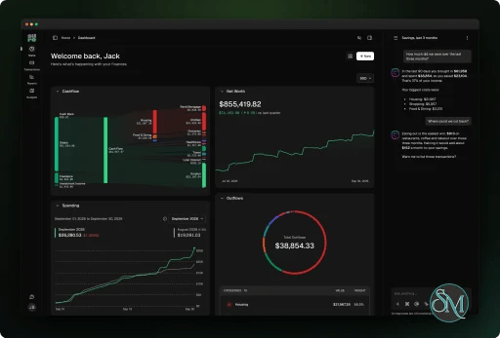


Sure is an open-source personal finance and wealth management application designed to help users manage their money while maintaining full control over their financial data. The application provides tools for tracking accounts and transactions, managing investments, creating budgets, and understanding personal net worth.
This project is a derivative of Maybe Finance, a personal finance platform that began as a commercial product before becoming open-source. Sure continues to expand its codebase with additional financial features, integrations, mobile support, and AI-driven tools.
Unlike purely cloud-based financial management services, Sure can be self-hosted on your own infrastructure using Docker, making it an attractive option for users who want a centralized financial dashboard without being entirely dependent on third-party hosting providers.
Features
Account and Financial Management
Sure supports different types of financial accounts, including cash, checking and savings accounts, credit cards, investments, and loans.
Users can organize their accounts and monitor balances from a centralized dashboard. This provides a consolidated view of their financial position without switching between multiple banking and investment applications.
The application also supports multiple currencies, account sharing, and financial data organization.
Transaction Tracking
Sure provides transaction management for recording and reviewing income, expenses, and transfers.
Users can categorize transactions, assign merchants, add tags, split transactions, and apply custom rules to organize financial activity.
Transaction filtering and reporting make it easier to investigate spending patterns and identify where money goes.
Automatic categorization and merchant detection can also reduce manual data entry, particularly when processing imported financial records.
Investment and Net Worth Tracking
Sure includes investment tracking and portfolio management features.
Users can monitor investment accounts, holdings, security prices, portfolio performance, and returns. The application also provides net worth calculations that combine assets and liabilities into a consolidated financial overview.
Loan management includes repayment schedules, interest information, and payoff projections, helping users understand outstanding debt and future financial obligations.
Budgeting and Financial Goals
Sure provides budgeting tools for organizing spending limits and tracking financial progress.
Users can create budgets, monitor category spending, and compare actual expenses against planned amounts.
Its planning features also support financial goals, allowing users to allocate money toward specific objectives and monitor progress over time.
Some newer planning capabilities are still designated as preview features, so their availability may depend on the deployment configuration.
Financial Institution Integrations
Sure supports connections to external financial data providers, allowing compatible accounts and transactions to be synchronized.
Its integration ecosystem includes services such as Plaid, SnapTrade, Wise, and other regional banking and investment providers.
Supported connections vary by provider, country, institution, and account type. Some integrations also require separate credentials or subscriptions.
For institutions without a suitable direct connection, users can work with imported financial data instead.
AI Financial Assistant
Sure includes an AI assistant that allows users to ask questions about their financial information using natural language.
It can retrieve account balances, search transactions, examine income and expenses, and provide information about budgets and net worth.
The AI system also supports background tasks such as transaction categorization and merchant detection.
Sure supports OpenAI-compatible providers and native Anthropic integration. Users can also configure local inference through services such as Ollama.
This flexibility allows self-hosters to choose between cloud-based models and locally hosted models, depending on their privacy, hardware, and performance requirements.
MCP Integration
Sure exposes a Model Context Protocol endpoint for external AI assistants and automation tools.
Compatible agents can access structured financial information through MCP tools, including accounts, transactions, budgets, holdings, and financial reports.
Depending on the available tools and permissions, agents can also perform supported operations such as updating transactions, managing budgets, and importing financial statements.
This makes Sure useful beyond its built-in interface. Developers can connect it to external AI agents and create custom financial workflows.
Web, Desktop, and Mobile Clients
The web application provides the complete financial management experience and serves as the primary interface.
Sure also provides a macOS desktop application built with Tauri and a Flutter-based mobile companion for Android and iOS.
The mobile application currently focuses on core functionality such as authentication and viewing account balances, while the web application provides access to the broader feature set.
The API and MCP interfaces provide additional integration options for developers and automation systems.
Self-Hosting and Data Ownership
One of Sure's main advantages is its self-hosting support.
The application can run on infrastructure controlled by the user, with financial records stored in its own database rather than requiring the user to depend on Sure's hosted service.
Its deployment architecture uses Ruby on Rails, PostgreSQL, Redis, and background workers.
Docker Compose simplifies deployment by providing the application services and their supporting dependencies.
Self-hosting provides greater infrastructure control, but users remain responsible for securing the server, managing credentials, maintaining backups, and protecting financial information.
Download Sure v0.7.6 - Personal Finance App - Software Mirrors |
|---|
Sure v0.7.6 - Personal Finance App for macOS |
Sure v0.7.6 - Personal Finance App for Android |
Sure v0.7.6 - Personal Finance App for iOS |
Sure v0.7.6 - Personal Finance App Source Code |
Sure v0.7.6 - Personal Finance App Release Notes:With this monthly release (we haven't missed that cadence in more than a year!) Sure now helps you understand what changed in your spending and see your loans in greater detail. From the balance remaining to how each payment divides between principal, interest and insurance. It also brings more control over transaction categorization, improvements to Bills, and expanded backup and restore tools. See what's different in your spendingThe new Spending vs normal visualization compares your spending with your own history. A category treemap shows where your money went, while a ranked list highlights what increased or decreased. Open a category to explore the transactions behind the change. Enable preview features to try it! 🚀 See where your money went—and which categories changed most compared with your usual spending. Get a clearer picture of your loansLoan accounts now go beyond a remaining balance. See your loan graphically alongside the original repayment schedule and a projection from today, with a breakdown of principal and interest over the life of the loan. The expanded overview brings together your interest rate, monthly payment, term, insurance costs and projected payoff date. Explore the repayment schedule payment by payment; for adjustable-rate loans, recorded rate changes are reflected in the schedule. Follow your mortgage from today's balance to projected payoff, with principal, interest and repayment details in one place. Control over categorization, and more!Test the token-free Bayes classifier against your own history, inspect its results, and tune its settings. Merchant matching and category classification now participate in the ordered rules list. Drag rules to choose their order, use Stop processing for exceptions, and split recurring transactions by amount or percentage. Hide dashboard widgets you do not need, drag accounts into your preferred order, and filter account activity by category, tag, merchant or transaction type. Amount fields support calculator expressions and comma decimals. The Flutter mobile app gains a read-only Budgets screen with month navigation, category progress, rollover amounts and transaction drill-down. The expanded backup tooling covers the database, local uploads, configuration and version information, with restore and rollback workflows, scheduled backups and optional off-site copies. It builds on the database-only backup sidecar from 0.7.5. Uploads stored in external object storage are not included and need their own backup. Backup folders contain configuration secrets and must be kept private. Product-improvement monitoring ⚠️ We added monitoring to help improve features such as the new Sankey chart and to understand how they are used. Self-hosters can turn off this anonymous product-improvement monitoring by setting Plus ...
Thank you to everyone contributing code, testing, bug reports and feedback. What's Changed
New Contributors
Full Changelog: v0.7.5...v0.7.6 |
Performance and Compatibility
Sure uses Ruby on Rails for its backend, PostgreSQL for persistent financial data, and Redis for background processing and supporting application services.
Its architecture separates web requests from background jobs, allowing operations such as financial synchronization, imports, and AI processing to run independently.
The application can be accessed through modern web browsers, while its desktop and mobile clients connect to the same backend server.
Performance depends on the deployment environment, database configuration, number of accounts, transaction volume, synchronization frequency, and background processing workload.
Large financial datasets and AI-related tasks can require additional memory and processing capacity. Administrators should also monitor PostgreSQL, Redis, and background worker performance as usage grows.
System Requirements
Sure is designed for self-hosted environments and requires several supporting services.
Typical requirements include:
Docker and Docker Compose for the recommended deployment method.
PostgreSQL for persistent application data.
Redis for background processing.
Sufficient RAM and storage for financial records, imports, and application services.
A compatible server environment with network access for financial integrations.
API credentials when using supported external financial data providers or cloud AI services.
Local AI inference requires additional hardware resources depending on the selected model. External AI providers require their own API credentials.
Pros and Cons
Pros
Open-source personal finance and wealth management application.
Supports self-hosting with Docker.
Centralized account and transaction management.
Investment, loan, and net worth tracking.
Budgeting and financial goal management.
Automatic transaction categorization.
Integrations with external financial data providers.
AI-powered financial assistant.
Supports OpenAI-compatible providers, Anthropic, and local LLMs.
MCP integration for external AI agents.
Web, desktop, and mobile clients.
Community-maintained development under AGPL-3.0.
Cons
Self-hosting requires database, Redis, and application maintenance.
Financial institution integrations vary by country and provider.
Some connections require third-party credentials or subscriptions.
Mobile functionality is more limited than the web application.
AI features require additional configuration and may incur API costs.
Local AI inference requires suitable hardware.
Users are responsible for backups and financial data security.
How to Install
Sure recommends Docker Compose for self-hosted deployments. The project provides example Compose configurations and environment templates to simplify setup.
Start by cloning the repository:
git clone https://github.com/we-promise/sure.git
cd sure
Prepare the environment configuration using the supplied example files and review the required settings, including database credentials, application secrets, and host configuration.
Start the application using Docker Compose:
docker compose up -dThe deployment starts the required application services, including the web application, background worker, and supporting infrastructure.
After the containers are running, access Sure through the configured server address and complete the initial account setup.
For AI functionality, configure an appropriate LLM provider separately. Sure supports OpenAI-compatible endpoints, Anthropic, and local inference through Ollama.
Refer to the official hosting documentation for production deployment, environment variables, database configuration, backups, and optional AI services.
Final Verdict
Sure is a compelling open-source personal finance platform for users who want greater control over their financial information. Its combination of account management, transaction tracking, investment monitoring, budgeting, and net worth reporting provides a comprehensive foundation for managing personal finances.
Its self-hosting architecture is particularly attractive. Users can operate the application on their own infrastructure, while the API and MCP integrations make it possible to connect external tools and AI assistants.
The AI functionality adds another useful dimension by allowing users to explore financial information through natural language and automate transaction categorization. However, financial institution connectivity still depends on supported providers, and the mobile application does not yet offer the full functionality of the web interface.
Overall, Sure is a strong choice for technically comfortable users who want an extensible, self-hosted alternative to commercial personal finance applications. Its community-driven development and growing feature set make it worth considering for long-term financial management.