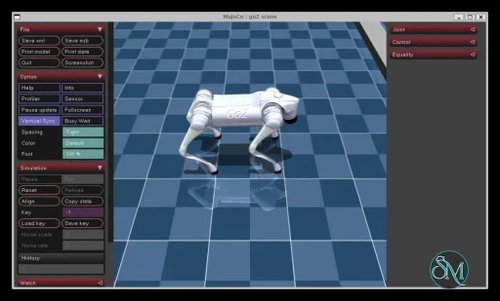
MuJoCo (Multi-Joint Dynamics with Coherence) is an open-source physics engine developed and maintained by Google DeepMind. It is designed to simulate composite structures and object interactions, making it highly useful for robotics, biomechanics, computer graphics, animation, and machine learning.
Unlike general-purpose physics engines used in games, MuJoCo focuses on the accurate and practical simulation of complex mechanical systems. It offers a native C API, visualization tools, Python bindings, and integration with various other development environments.
The combination of its simulation capabilities, computational tools, and compatibility with machine learning makes it a popular choice for researchers and developers working in the fields of robotics and reinforcement learning.
Features
High-Performance Physics Simulation
MuJoCo provides a physics engine optimized for simulating articulated systems interacting with their environments.
It handles rigid bodies, joints, constraints, collisions, friction, and contact forces. Its simulation architecture uses preallocated data structures to reduce runtime overhead and improve computational efficiency.
This makes it suitable for applications involving robotic arms, humanoid robots, legged locomotion, mechanical systems, and other complex physical models.
MJCF Model Description
MuJoCo uses its own XML-based modeling format called MJCF (MuJoCo XML). It allows developers to describe physical environments, including bodies, joints, geometries, actuators, sensors, materials, and simulation parameters.
The built-in XML compiler converts these descriptions into optimized simulation structures.
MJCF also supports reusable components, procedural model construction, and external assets, making it easier to manage complex simulation environments.
MuJoCo additionally supports URDF model import, allowing developers to work with robot descriptions from other robotics tools.
Contact and Collision Simulation
One of MuJoCo's defining capabilities is its handling of contact dynamics.
It provides collision detection and constraint-based contact simulation for objects interacting with each other or their surroundings.
The engine supports different collision geometries, friction models, and contact parameters. These features are particularly important for robotics research, where realistic interaction between robots and objects is essential.
Its contact solver is designed to provide stable and efficient simulation rather than relying exclusively on conventional rigid-body collision handling.
Robotics and Actuator Simulation
MuJoCo provides extensive support for modeling robotic mechanisms.
Developers can define joints, actuators, transmissions, sensors, and control inputs to simulate robotic movement and behavior.
It supports different joint configurations, including hinge, slide, ball, and free joints. Actuator models can represent motors and other mechanisms used to control simulated robots.
This makes it useful for testing robotic control algorithms before deploying them on physical hardware.
Python Integration
MuJoCo provides official Python bindings through the mujoco package.
Developers can load models, control simulation steps, access physical state information, modify model parameters, and interact with the simulation directly from Python.
Installation is straightforward:
pip install mujoco
The Python package includes the native MuJoCo library, so a separate installation of the C/C++ runtime is generally unnecessary.
The Python API is particularly useful for machine learning experiments, robotics research, simulation automation, and reinforcement learning environments.
Reinforcement Learning and MJX
MuJoCo is widely used in reinforcement learning research because it provides efficient and repeatable physics simulations.
Its ecosystem includes MJX, an implementation built using JAX that enables physics simulation on supported accelerators.
MJX makes it possible to explore batched simulation, accelerator-based computation, and differentiable physics workflows.
These capabilities are valuable when training robotic control policies that require large numbers of simulation steps.
Interactive Visualization
MuJoCo includes a native visualization application called simulate.
It allows users to load models, inspect simulated environments, interact with objects, and observe physical behavior in real time.
The visualization system uses OpenGL and provides tools for examining simulation states, contacts, and other physical properties.
MuJoCo also offers MuJoCo Studio and browser-based visualization through its WebAssembly implementation.
Plugin Architecture
MuJoCo supports plugins that extend its simulation capabilities.
Plugins can introduce custom sensors, actuators, modeling components, and other functionality without requiring developers to modify the core engine.
This makes the architecture suitable for specialized robotics applications and experimental simulation features.
Unity Integration
MuJoCo provides a Unity plugin for developers who want to combine its physics simulation capabilities with the Unity development environment.
This is useful for robotics visualization, interactive simulation environments, and applications that benefit from Unity's rendering and user interface tools.
Additional language integrations are available through community projects, including Java, Rust, Julia, and Swift bindings.
Download MuJoCo 4.0.0 - Physics Engine - Software Mirrors |
|---|
MuJoCo 4.0.0 - Physics Engine for Windowsmujoco-4.0.0-windows-x86_64.zip | 21.64 MB |
MuJoCo 4.0.0 - Physics Engine for macOSmujoco-4.0.0-macos-universal2.dmg | 54.9 MB |
MuJoCo 4.0.0 - Physics Engine for Linuxmujoco-4.0.0-linux-x86_64.tar.gz | 33.72 MB mujoco-4.0.0-linux-aarch64.tar.gz | 33.19 MB |
MuJoCo 4.0.0 - Physics Engine Source CodeMuJoCo 4.0.0 - Physics Engine Source code (zip) MuJoCo 4.0.0 - Physics Engine Source code (tar.gz) |
MuJoCo 4.0.0 - Physics Engine Release Notes:Version 4.0.0 (November 6, 2026)[!IMPORTANT]
Read the MuJoCo 4.0 announcement for an overview of everything new since 3.0, the interactive showcase at mujoco.org, MuJoCo Live browser demos, visual showcases, and maintainer Q&A.
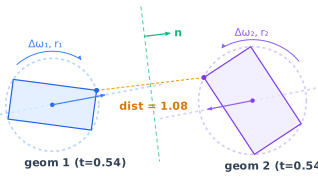 Significant new features timestep. On the right, one step of conservative advancement between two rotating boxes. See model/speculative/ for examples.
-- (spatial, fixed) springs (left). -- (yield) for 2D and 3D flexes, with separate stretching and -- bending yield strains for 2D shells, volumetric-deviatoric (von Mises $J_2$) stretching and 2D shell bending -- return mapping (right).  
on numpy), mujoco-studio (Studio and Filament renderer bindings), and mujoco (default package installing both). When upgrading from a pre-split mujoco installation with pip, uninstall first (pip uninstall -y mujoco && pip install mujoco) or run pip install --force-reinstall --no-deps mujoco mujoco-core mujoco-studio after upgrading so pip does not remove files moved to mujoco-core. To switch an existing mujoco installation to core-only, run pip uninstall -y mujoco mujoco-studio && pip install --force-reinstall --no-deps mujoco-core. [!NOTE]
Updated documentation for the split Python packages (mujoco, mujoco-core, mujoco-studio) and prebuilt OpenUSD wheels (mujoco-usd / mujocousd]) landed shortly after the 4.0.0 release ([39ddbb61a). Please refer to the latest docs for Python bindings and OpenUSD rather than stable or 4.0.0.
Engine[!WARNING]
Breaking changes
> 4. a65050166 Changed the semantics of sidesite: the tendon now goes around
the geom the same way as the path from the first endpoint, through the side site, to the second endpoint (thin
grey line below). Formally, the tendon is the shortest path homotopic to this polyline in the wrapping plane with
the geom removed.
>
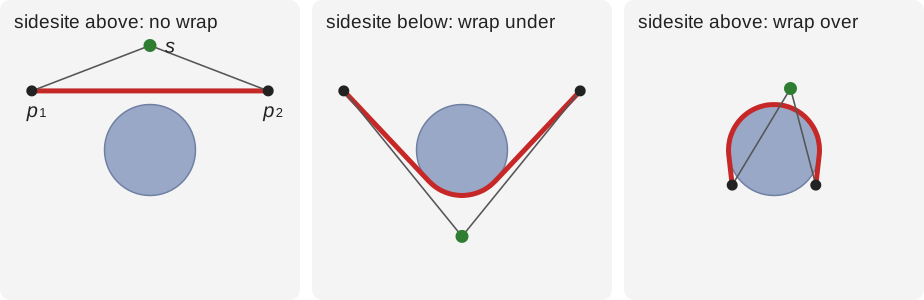
> Previously, a half-plane test was used, which could make the tendon jump onto the geom, a discontinuity in tendon
length, when the segment between the endpoints moved away from the side site while clear of the geom. It could
also select the wrong side for wraps longer than 180 degrees. Top row: old rule; bottom row: new rule.
>
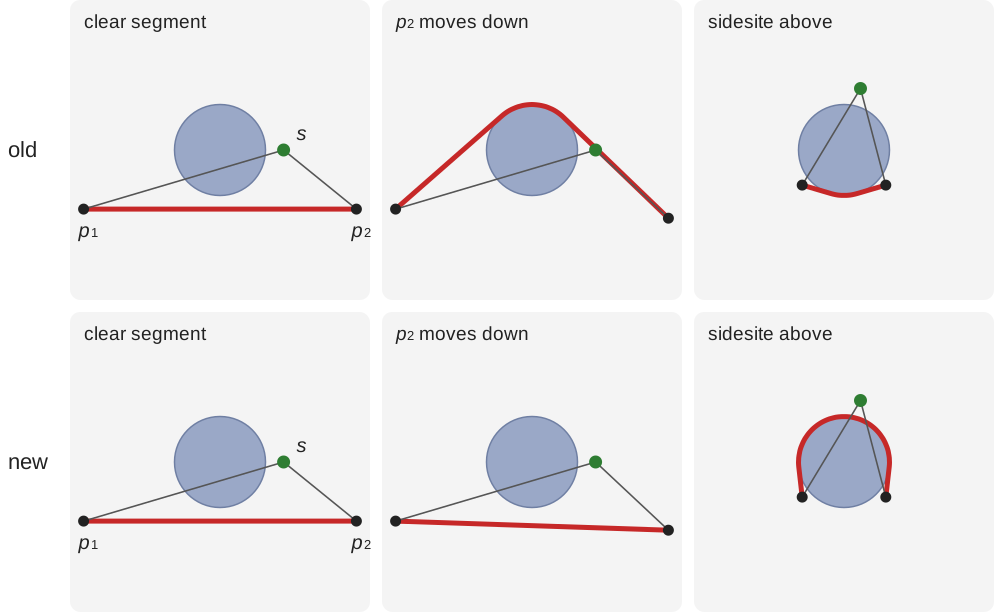
> The new rule has a single discontinuity: when an endpoint crosses the ray opposite the side site, the path
through the side site changes its winding around the geom and the tendon snaps off. This can change the behavior
of existing models.
> Migration: Place side sites so that the endpoints do not cross this ray over the range of motion, typically
near the middle of the wrapped arc. For example, the side sites of the
two-link arm were moved from
directly below the joints to 45 degrees below the arm, which reproduces the previous tendon lengths exactly.
orientations of ball and free joints. Previously, the angular velocities of the Runge-Kutta stages were combined without the Runge-Kutta-Munthe-Kaas correction, so orientations converged only at second order. This changes the simulation of models with ball or free joints that use RK4. surface velocity (geom[1] minus geom[0]) in the contact frame (tangent1, tangent2, spin). Collision detection populates it from geom_surfacevel when mjModel.flg_surfacevel is set, and external contact generators can write it directly (setting flg_surfacevel = 1 if no geom specifies surfacevel). Contact-point visualization now draws a single relative tangential velocity arrow per active frictional contact. quaternion orientations of body inertias, geoms, and sites alongside ximat, geom_xmat, and site_xmat. fixed and spatial tendons. Previously, the type was implied by whether the first path element was a joint. Deformables[!WARNING]
Breaking changes
> 9. 1d6cc8ff5 Removed the cable plugin (plugin/elasticity) and the composite element, which are
superseded by 1D flexcomp with elasticity.
> Migration:
> - count and curve / size / vertex: use flexcomp dim="1" with
-- type="grid", count, and spacing (or type="circle" for closed loops), or type="direct" with
-- point. Add <edge equality="true"/> to keep edges inextensible.
> - Geom size (capsule radius): set flexcomp radius. For geom type="box", set
-- <elasticity section="box" sectionsize="..."/>.
> - Plugin bend and twist: set <elasticity young="..." shear="..."/>.
> - Root attachment initial: initial="none" maps to <pin id="0 1"/> (clamps the first edge's material
-- frame to the parent body and omits <name>_twist_0); initial="ball" maps to <pin id="0"/> (spherical
-- anchor at the first vertex, keeping <name>_twist_0 free); initial="free" maps to no <pin/>.
> - Plugin flat="true": define the rod straight in qpos0 (e.g., type="grid") and set the curved initial
-- pose via qpos or a keyframe (curves defined directly in point are at rest in qpos0,
-- corresponding to flat="false").
> - Plugin vmax stress coloring: not supported.
> - Integrator: use integrator="discrete" for implicit integration (or Euler / RK4; implicit and
-- implicitfast are not supported for 1D rod elasticity).
> - Body names B_first / B_ / B_last: unpinned vertices create bodies <name>_ (pinned
-- vertices attach directly to the parent body), plus per-edge twist bodies and joints (see the next entry).
> 10. 95cf15e58 Open elastic 1D flexcomps with at least two elements now create
-- per-edge twist bodies with hinge joints <name>_twist_0, ..., <name>_twist under the world body (omitting
-- the joint of an edge clamped by pinning both of its points: <name>_twist_0 for <pin id="0 1"/>, and
-- <name>_twist for the last two points of a rod with at least three elements), and store their time-parallel
-- reference frames and reference twists in mjData.plastic. This changes nq, nv, nbody, nplastic</blockquote> -- and the qpos layout of such models, shifts the indices of bodies and joints declared after the flexcomp, and
-- changes the simulation: rods now roll on surfaces and twist in grippers. Box sections (section box)
-- require these joints, so raw flexes with box sections now need them too, and their
-- collision radius is set to the minor half-size of the section (an explicit radius that differs from
-- it is now a compile error).
> -- Migration: Update keyframes and any code that indexes qpos, qvel or bodies by number, preferably
-- addressing vertex bodies (<name>_) and twist joints by name. Save and restore rod state with
-- mjSTATE_PLASTIC. Raw box-section flexes need hinge joints named as above (see
-- elasticity).
> 11. 7ba52b533 Fixed the elastic constants of non-interpolated flexes (full and
-- radial dofs), which now match young,
-- poisson and thickness as documented, and the
-- interpolated flexes:
> -- - 3D Saint Venant-Kirchhoff stretching used twice the first Lamé parameter $\lambda$.
> -- - 2D stretching used a quarter of the shear modulus $\mu$ and half of the 3D $\lambda$, instead of
-- $\mu$ and the plane-stress $\lambda^* = E \nu / (1 - \nu^2)$.
> -- - 2D bending used $\tfrac{3}{4}(1-\nu) D$ instead of the plate bending rigidity
-- $D = E t^3 / (12 (1 - \nu^2))$.
> -- Models with these flexes become stiffer, except 3D models with zero Poisson's ratio, which are unchanged.
> -- Migration: To keep the previous behavior, use these parameters:
> -- - 3D: $\nu' = 2\nu / (1 + 2\nu)$ and $E' = E (1 + \nu') / (1 + \nu)$.
> -- - 2D bending only (elastic2d="bend"): $E' = \tfrac{3}{4}(1 - \nu) E$.
> -- - 2D stretching (elastic2d="stretch" or "both"): $\nu' = 2\nu$, which is exact for
-- $\nu < 1/4$ (so that $\nu' < 1/2$). Then:
> -- - "stretch": $E' = E (1 + 2\nu) / (4 (1 + \nu))$.
> -- - "both": $t' = t \sqrt{3 (1 - 2\nu)}$ and $E' = E t (1 + 2\nu) / (4 (1 + \nu) t')$.
> -- The flex models in model/flex were remapped in this way, so their behavior is unchanged.
> 12. c0e6b15fd 1D rod bending elasticity (dim="1" with positive young) is no
-- longer supported under implicit and implicitfast, matching 2D and 3D flex elasticity.
> -- Migration: Use integrator="discrete" for implicit integration, or integrator="Euler" with a small
-- timestep for explicit integration.
> 13. c0e6b15fd Flex edge stiffness and damping are no
-- longer supported under integrator="discrete" (where they were integrated explicitly rather than in the
-- effective metric).
> -- Migration: Use elasticity (or edge equality), or use
-- Euler/RK4/implicitfast.
> 14. b2577a630 Unpinned flexcomp models (with full, trilinear, or
-- quadratic dofs) now fail to compile if their parent or ancestor body has joints
-- when no active vertices or nodes are pinned to it.
> -- Migration: Remove joints from the parent/ancestor body of an unpinned flex, or pin at least one vertex/node to
-- the parent body with pin.
> 15. 145cdc2be Removed flexvert equality constraints (<equality> and
-- <edge equality="vert"/> in flexcomp), along with the associated mjModel fields
-- (nJfv, flex_vertedgeadr, flex_vertedgenum, flex_vertedge, flex_vertmetric,
-- flexvert_J_rownnz, flexvert_J_rowadr, flexvert_J_colind) and mjData fields
-- (flexvert_length, flexvert_J). mjEQ_FLEXVERT is retained as an unsupported placeholder in
-- mjtEq and causes an error if used.
> -- Migration: Use continuum elasticity with integrator="discrete" or
-- edge equality for 2D cloth models.
> 16. 6f28d4adf Flexes now support per-element visual materials: mjModel.flex_matid is now
-- (nflexelem x 1) instead of (nflex x 1), and the material attribute on flex
-- and flexcomp (mjsFlex.material) is now mjStringVec rather than mjString</blockquote> -- (accepting either a single material name broadcast to all elements or one material name per element).
> -- Migration: Index mjModel.flex_matid by element m->flex_elemadr[f] + e rather than by flex f. In C,
-- set mjsFlex.material with mjs_setStringVec (or mjs_appendString) instead of mjs_setString; in
-- Python, assign a list of material names (e.g. flex.material = ['mat']).
> 17. 7ba5d6732 Records of 1D flexes in mjModel.flex_bending grow from 4 to 10 values, to store curved
-- reference configurations and pairs of adjacent bent vertices. Previously, each record was
-- [v_prev, v, v_next, k].
> -- Migration: Read 1D records with stride 10. A record whose fourth value is negative is a single hinge
-- [v0, v1, v2, -1, k1, k2 - k1, |kb0|, jnt, kt, b]: principal bending stiffnesses k1 <= k2, the twist hinge
-- joint jnt of the edge (v1, v2) (-1 if none; the joint of the first edge, when present, is that of the
-- first record minus one), torsional stiffness kt, and the signed minor half-size b of a box section (0
-- for circular sections). Otherwise it is a hinge pair [v0, v1, v2, v3, w0, w1, om0[4]].
18. 8892bf44b, 0d8a109de, f9a589361 Sparse Newton (solver) is -- 1.4-3x faster on flex models, using fill-reducing DOF ordering, incremental active-set -- Hessian updates, direct elliptic cone folding, and pre-ordered sparse Cholesky for the 2D -- discrete integrator smooth solve. Most flex models in model/flex now use -- solver="Newton", and the experimental ipc flag now supports solver="Newton" in -- addition to solver="CG". 19. 57d9b960f solver="Newton" with the discrete integrator now supports -- flex vertices and nodes (both standard and interpolated) attached to articulated bodies. -- Previously, such models required solver="CG". The model/flex/gripper_trilinear.xml gripper now uses -- solver="Newton". MuJoCo Warp still requires solver="CG" for such models. 20. 7ba5d6732 1D rod bending elasticity now supports curved reference configurations -- and torsional stiffness: vertices bent by more than $10^{-4}$ rad in qpos0 keep their reference curvature -- and dihedral twist angle, so that rods such as rings, arcs, and coil springs are at rest in their compiled shape. -- Previously, such models failed to compile. The new shear attribute optionally -- overrides the shear modulus used for torsion. Open rods carry per-edge twist joints (see the breaking change above) -- with per-edge polar inertia, frame-indifferent relative Rayleigh torsional damping, time-parallel reference frames, -- and frictional contact lever-arm coupling. Box sections additionally use anisotropic principal stiffnesses with -- equalized damping ratio ($\sqrt{k_1 k_2}$ on the weak axis) and an oriented box in the DER material frame for -- rendering and collision detection. See the documentation. 21. 9ca6b7171 Volumetric interpolated flexes (trilinear or quadratic dofs -- with elastic2d="none") now integrate cell stiffness and lump nodal masses over the mesh volume using Finite Cell -- Method (FCM) subcell quadrature instead of treating every non-empty grid cell as a full cube. This changes the -- stiffness and nodal mass distribution of volumetric interpolated flexes whose mesh does not fill its bounding box, -- as well as the nodal mass distribution of multi-cell trilinear flexes. 22. f9f3ee653 Contacts with flex elements now distribute the contact to the element vertices with the -- barycentric coordinates of the point on the element closest to the contact. Previously the vertex weights were -- inversely proportional to the distances from the contact, which do not interpolate the contact point: the contact -- Jacobian measured the velocity of a different material point, and the contact force exerted a spurious torque on the -- element. This changes the simulation of models with flex contacts. 23. 115907e6d Interpolated flexes (trilinear or quadratic dofs) now support -- passive contact. 24. 51572eab0 Flex edge damping is now integrated explicitly under implicit and -- implicitfast (previously it also damped rigid translation). 25. 9fb4eca48 Fixed contact Jacobians of quadratic flexes, which dropped nodes with negative basis weights. 26. b16e09838 Sphere and capsule contacts with 3D flex elements are now computed analytically instead of the -- general convex pipeline. 27. 3bbf510d4 Improved numerical stability of nativeccd convex collision -- detection and multiccd contact generation. This can slightly change contacts for models -- with convex or mesh collisions. Compiler[!WARNING]
Breaking changes
> 28. 00057bcef Models that include the same file through different paths, which previously
-- loaded, are now rejected with already included.
> -- Migration: Remove redundant <include> elements referencing the same file.
> 29. The compiler now rejects the following invalid models, which previously loaded:
> -- - b6192732b Height fields with nrow or
-- ncol less than 2.
> -- - a4c699040 Fixed tendons referencing ball/free or duplicate joints, or
-- with negative armature.
> -- - a4c699040 Spatial tendon pulleys with non-positive
-- divisor.
> -- - a4c699040 camprojection or camera-attached
-- rangefinder sensors referencing an invalid camera or a camera with non-positive
-- resolution.
> -- - 881e53e2e Skins with out-of-range face vertex indices.
> -- - 881e53e2e mjs_makeMesh mjMESH_BUILTIN_CONE calls with fewer than 3 edges or radius</blockquote> -- outside [0, 1].
> -- Migration: Ensure height fields have nrow >= 2 and ncol >= 2, fixed tendons wrap distinct slide</blockquote> -- or hinge joints with non-negative armature, pulley divisors are positive, cameras referenced by
-- camprojection or rangefinder sensors have positive resolution, skin face indices are in [0, nvert),
-- and cone meshes have at least 3 edges and a radius in [0, 1].
30. 432376a59 fullinertia and inertias inferred from geoms which are not -- positive definite are now bounded by boundinertia when it is positive. Previously they -- gave a compile error. 31. a4c699040 mj_encode now supports binary MJB output for mjSpec via the -- model/vnd.mujoco.mjb content type. Rendering 32. 1edd2c67d Added a castshadow attribute to geom -- (mjsGeom.castshadow, mjModel.geom_castshadow, mjvGeom.castshadow; default true) to disable shadow -- casting per geom in both the classic OpenGL and Filament renderers, and mjrf_setRenderableCastShadow -- (mjrf.Renderable.set_cast_shadow in Python) to toggle shadow casting of Filament renderables dynamically. 33. c831b97d6 Added horizon haze and skybox visibility support to Filament rendering: infinite planes are -- centered beneath the camera and blend smoothly into the skybox horizon according to -- visual/map/haze and visual/rgba/haze, toggled per view via haze -- and skybox on mjrfRenderRequest (mjRND_HAZE and mjRND_SKYBOX). 34. 939bc882e When no light specifies an intensity, the fallback intensity given -- to each light in Filament rendering is now scaled by the brightness of its diffuse color, which is factored out of -- the light's color. Lights look the same, but the brightest directional light now casts the shadows, rather than an -- arbitrary one that could differ between runs. 35. 0fc0b44d6 Added filament.material.base_color_type flag for configuring how the base color -- material parameter is interpreted. 36. e19117325 Added mjrf_flush (mjrf.Context.flush in Python) to flush pending operations to the -- rendering backend and invoke any completed callbacks. 37. 93033f5ba Added mjRND_POST_PROCESSING rendering flag. 38. e66b53380 Allow headlight.active to be set to "false", "true", or "auto" -- while continuing to support integer values (0=false, 1=true, 2=auto). Change the default to "auto" instead of -- "true". Python bindings 39. 68390c316 Removed support for Python 3.10, now that it's -- deprecated upstream. 40. a1b9fce44 Bundled the MuJoCo Sphinx manual (doc//.rst) and agent skills (doc/skills//.md) -- inside the mujoco package under mujoco/doc/. Samples[!WARNING]
Breaking changes
> 41. 006586d30 Removed sample/record.cc; multi-frame raw RGB24 video recording is now supported by
-- sample/render.cc across both the Filament and classic OpenGL backends via --duration and
-- --fps.
> -- Migration: Replace record model.xml T F out.rgb 0 with
-- render model.xml out.rgb --duration=T --fps=F (or pass - as the output path to pipe top-down RGB24 frames
-- directly to ffmpeg; vflip is no longer needed).
Models 42. 9647e0290 Added six -- elasto-plasticity example models, each -- placing an elastic reference next to a plastic counterpart: joint and tendon springs, 2D shells and 3D continua. 43. 89daf8d19 Added -- speculative contacts example models: a -- Newton's cradle of thin plates, an interlocking chain, and a ball struck by a hinged flipper. Documentation 44. 74ad32d20 Added documentation for MuJoCo Studio, covering web -- and native viewers, architecture, and -- Python and C++ development. 45. 0f1092ebb Added a Model tuning guide to the Modeling chapter---covering the -- fidelity--speed trade-off, tuning defaults, priority-ordered global -- and model-level parameters, deformables, and -- system identification---along with module documentation for mujoco.sysid. Bug fixes 46. fdf141238 accelerometer and framelinacc sensors -- and mj_objectAcceleration on static and mocap bodies now report the gravitational proper acceleration, like a -- dynamic body at rest. Previously they returned zero, a regression introduced in 3.3.7. 47. c4137ef7c, aeb871ba1 Actuators saturated by joint or tendon actuator force limits -- (joint and tendon -- actuatorfrcrange) no longer contribute implicit actuator derivatives, changing integration under implicit, -- implicitfast, and discrete. Because saturated actuators no longer contribute implicit damping, models with -- light links and no armature may need joint armature or a smaller timestep. 48. aaf2abaa7, 1b46a496e Fixed sleep filtering bugs in history sensors -- (nsample, delay, interval), mj_energyPos, flex passive forces, tendon limit and -- frictionloss constraints, two-tree tendon armature and bias, mj_subtreeVel, and -- caller-supplied mj_rne buffers. 49. 13fb7844e mj_setConst now wakes all sleeping trees, since it recomputes their -- kinematics at qpos0 and qpos_spring. Previously their cached poses could be left at qpos_spring. It also -- no longer overwrites cam_xpos, cam_xmat, light_xpos and light_xdir in mjData, which left -- static cameras and lights with tracking or targeting at their fixed-mode poses. 50. 432376a59 Contact pairs created with an undefined mjsPair.solref now mix the solref of their geoms -- using solmix when both are positive, like contacts not defined by pairs. Previously they always took the -- element-wise minimum. 51. 18d65f4e0, ea6aa8214 Filament depth and segmentation renders no longer apply post-processing -- (tone mapping, dithering), which corrupted depth values and segment ID colors; perspective depth renders now project -- with the finite zfar plane instead of Filament's infinite far plane, matching orthographic -- depth and the classic renderer; and the mjr_ compatibility API now respects readDepthMap -- (mjtDepthMap) on mjrContext in mjr_readPixels and colors geoms by segid + 1 like -- mjRND_IDCOLOR so a geom with segid 0 no longer renders as background. 52. 9b19fd07c, ef34acbee File paths on Windows are now interpreted as UTF-8 rather than the active -- ANSI code page, fixing loading and saving files, plugin library discovery and loading (mj_loadPluginLibrary, -- mj_loadAllPluginLibraries), and simulate executable directory lookup when paths contain -- non-ASCII UTF-8 characters (#3139). Contribution by @mar-yan24. 53. a5ff8f6c7 Fixed dcmotor parameter handling: allow zero -- motorconst for input="none", reject negative constants (e.g. -- motorconst="-a b" is now rejected instead of silently using K = b), replace capacitance when an inconsistent -- thermal triple is given, clear inherited -- forcerange when saturation is authored, let -- zero saturation or inductance clear class defaults, and validate actdim at -- compile time. 54. 8694cc9ce Improved numerical stability of sphere and cylinder spatial tendon -- geom wrapping at wrap onset. Thanks to @M-Colley for reporting and analyzing the -- issue in MJWarp issue 1772. 55. b6192732b mj_ray now scales SDF hit distances by 1 / ||vec|| for non-unit ray vectors, and -- mju_rayTriangle rejects triangle intersections behind the ray origin. 56. 00c19f04b mj_resetData, mj_copyData, and mj_recompile now preserve the destination -- mjData thread pool instead of dropping and leaking it. 57. a206daa42 mju_mat2Rot now normalizes the input quaternion and escapes 180-degree stationary points -- (saddles and minima) that do not maximize $\operatorname{tr}(R^\top M)$. 58. afa16414c Fixed the cotangent weight and length scale of the curved reference term of 2D -- flex bending (elastic2d bend or both), so -- out-of-plane bending forces vanish at curved rest configurations and scale consistently with model size. 59. a4c699040 Fixed several bugs when editing or copying an mjSpec: -- - mjs_delete (MjSpec.delete in Python) now removes deleted default classes from the class lookup map -- instead of leaving dangling pointers. -- - mj_copyBack (MjSpec.copy_back in Python) preserves material metallic, roughness, and -- texuniform attributes. -- - mjs_findChild no longer matches a non-world body against itself. -- - mjs_setToMuscle accepts NULL timeconst and range pointers. 60. 00057bcef Fixed several MJCF XML loading and saving bugs: -- - include no longer double-prefixes the model directory on nested or relative paths. -- - Loading MJCF now applies enclosing frame transforms to flexcomp, and allows -- explicit range or inheritrange attributes on actuator shortcuts to -- override conflicting defaults. -- - default/tendon now accepts armature, -- actuatorfrclimited, and -- actuatorfrcrange, which were previously emitted when saving XML and then -- failed schema validation on reload. -- - Saving MJCF (mj_saveLastXML, mj_saveXML, mj_saveXMLString) now preserves -- texture nchannel and clamps emitted -- gridlayout to gridsize (while loading resets gridlayout when an authored -- gridsize differs from the inherited default), compares material layer textures, camera -- sensorsize, and light texture against default classes, and -- writes all attributes on plugin-backed meshes and reftype/refname on plugin sensors. 61. 881e53e2e Legacy .msh meshes with mirrored scale no longer double-flip face -- winding (which inverted faces), and .msh files without vertex normals no longer populate empty face normals or -- reject custom normals on recompilation.
-- Update (November 7, 2026, 01:00 PST): The four standalone release archives (mujoco-4.0.0-linux-x86_64.tar.gz, mujoco-4.0.0-linux-aarch64.tar.gz, mujoco-4.0.0-windows-x86_64.zip, and mujoco-4.0.0-macos-universal2.dmg) and their .sha256 checksum files were rebuilt and replaced to remove usd_decoder_plugin from the simulate auto-load plugin directory, fixing a startup crash when Python/OpenUSD runtime libraries are not installed. The 4.0.0 Git tag, PyPI wheels, and npm WASM package are unchanged.
|
Performance and Compatibility
MuJoCo is designed around computational efficiency and accurate physics simulation.
Its C API provides direct access to simulation structures, while preallocated memory and optimized numerical algorithms help reduce runtime overhead.
The engine supports Linux, Windows, and macOS, with prebuilt binaries available for x86-64 and ARM64 platforms.
Developers can use MuJoCo through C/C++, Python, Unity, and other language integrations.
For machine learning workloads, MJX provides an alternative implementation using JAX, allowing compatible simulation operations to run on accelerators.
Actual performance depends on model complexity, collision geometry, solver settings, simulation frequency, and hardware capabilities. Large environments and complex contact interactions can still require substantial computational resources.
System Requirements
MuJoCo has relatively modest requirements for basic simulation, although more complex robotics and machine learning workloads benefit from stronger hardware.
Typical requirements include:
Linux, Windows, or macOS.
A compatible 64-bit processor.
OpenGL-compatible graphics hardware for native visualization.
Sufficient RAM for simulation models and application data.
CMake and a C++17 compiler when building from source.
Python 3.11 or newer for the current Python package, according to the repository's installation documentation.
Additional requirements depend on the selected integrations. MJX requires its Python and JAX dependencies, while Unity development requires a compatible Unity environment.
Pros and Cons
Pros
High-performance physics simulation.
Accurate articulated-body and contact dynamics.
Designed for robotics and biomechanics research.
Supports MJCF and URDF-based workflows.
Official Python bindings.
Integration with JAX through MJX.
Includes interactive visualization tools.
Supports custom simulation plugins.
Unity integration.
Available for Linux, Windows, and macOS.
Open-source under Apache-2.0.
Cons
Primarily designed for technical users and researchers.
Requires understanding of physics modeling and simulation concepts.
MJCF has a learning curve for beginners.
Complex environments can require substantial computational resources.
Some integrations require additional dependencies.
Not intended to replace general-purpose game engines.
How to Install
MuJoCo provides precompiled libraries for Linux, Windows, and macOS. These are the recommended option for developers who simply want to use the simulation engine.
For Python users, installation through PyPI is straightforward:
pip install mujoco
The package includes the native simulation library and Python bindings.
Developers who want to build the C/C++ engine from source need CMake and a compatible C++17 compiler.
Clone the repository and create a separate build directory:
git clone https://github.com/google-deepmind/mujoco.git

cd mujoco

mkdir build
cd build
Configure and compile the project in Release mode:
cmake ../ -DCMAKE_BUILD_TYPE=Release
cmake --build . --parallel
To install the compiled files into a custom directory:
cmake ../ -DCMAKE_BUILD_TYPE=Release \
  -DCMAKE_INSTALL_PREFIX=/opt/mujoco

cmake --build . --parallel
cmake --install .
The build system automatically downloads required dependencies through CMake FetchContent. Python bindings require a separate build process if they also need to be compiled from source.
Final Verdict
MuJoCo is an excellent physics engine for developers and researchers working with robotics, biomechanics, and machine learning. Its focus on articulated-body dynamics, contact simulation, and computational efficiency makes it particularly valuable for applications where accurate physical behavior matters.
Its official Python bindings and MJX implementation also make it an attractive platform for reinforcement learning experiments. Meanwhile, its C API, plugin architecture, and Unity integration provide flexibility for more specialized development projects.
The main limitation is its learning curve. MuJoCo is a technical simulation framework rather than a beginner-friendly visual application. Understanding MJCF, physical parameters, actuators, and contact dynamics requires some knowledge of physics and robotics.
Overall, MuJoCo is a powerful open-source choice for anyone developing robotic systems, training control algorithms, or researching physically accurate simulations.
Sources