
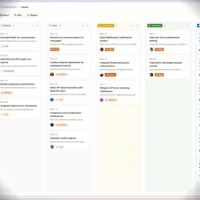


Looper is an open source AI development automation tool that turns coding agents into an autonomous development team. Instead of simply asking an AI agent to complete a task, Looper gives specialized agents clear responsibilities and lets them repeatedly plan, review, fix, and implement code until predefined success criteria are met.
The project is particularly interesting for developers who already use tools such as Claude Code, Codex, OpenCode, Cursor CLI, or other coding agents and want to automate more of the software development lifecycle without handing control to a hosted platform.
Looper runs locally as a daemon and monitors registered GitHub or Forgejo repositories. Work starts from issues and pull requests rather than from a separate task management system.
Its workflow is divided into four specialized loops:
Planner
Reviewer
Fixer
Worker
The planner turns an issue into a concrete specification. The reviewer evaluates the resulting pull request, the fixer responds to review feedback, and the worker implements the approved specification. These agents continue working until their respective success conditions are satisfied.
This approach is quite different from a traditional AI coding assistant. Instead of continuously prompting an agent yourself, Looper attempts to create an autonomous development pipeline around existing coding agents.
Key Features of Looper
Autonomous Development Loops
Looper's main attraction is its loop-based architecture. Each agent keeps working toward a defined outcome instead of stopping after a fixed number of steps.
The planner works until the specification is ready for review. The reviewer and fixer can repeatedly interact until actionable review comments have been addressed, while the worker continues implementing until checks pass and the pull request is ready for human review.
GitHub and Forgejo Integration
Looper uses the source-control platform itself as the workflow system. Issues, pull requests, labels, reviews, and assignments determine what work should happen.
This means there is no requirement for another project-management service just to coordinate the AI agents. GitHub is supported directly, while Forgejo is also supported for several workflow operations.
Multiple Repositories
A single Looper daemon can monitor multiple repositories and run workflows across them in parallel.
This is useful for developers or organizations maintaining several projects because the same local automation infrastructure can handle different repositories without requiring a separate installation for each one.
Isolated Git Worktrees
Every loop runs in its own Git worktree. This is an important design choice because multiple agents can work simultaneously without modifying the same working directory.
It makes parallel execution considerably safer and reduces the possibility of agents interfering with one another's files.
Bring Your Own AI Agent
Looper does not lock users into one AI provider. Its vendor layer supports agents including OpenCode, Claude Code, Codex, Cursor CLI, and Grok Build.
This is one of its biggest advantages. Users can continue using the coding agent they already prefer instead of adopting another proprietary AI environment.
Pull Request Takeover
Looper can take over an individual pull request and continuously run reviewer and fixer loops against it.
This is particularly useful when a developer wants an AI agent to handle repetitive review feedback without manually prompting the agent after every change. The process can continue in the background through the Looper daemon.
Local and Inspectable
Looper runs locally rather than relying on a hosted control plane. The CLI provides commands for inspecting active loops, viewing logs, stopping runs, and accessing worktrees.
This gives developers considerably more visibility into what their automation is doing than a completely managed cloud-based AI development service.
Networked Operation
For more advanced environments, Looper supports routed multi-node operation. This allows multiple Looper nodes to participate in a coordinated setup while GitHub remains the authority for work intent.
Download Looper v0.14.0 - Software Mirrors |
|---|
Looper v0.14.0 for macOS |
Looper v0.14.0 for Linux |
Looper v0.14.0 Source Code |
Looper v0.14.0 Release Notes:What's Changed
New Contributors
|
Performance and User Experience
Looper is primarily a developer and DevOps tool rather than a traditional desktop application. Its CLI-oriented design is appropriate for users who are comfortable with Git, GitHub, terminals, and AI coding agents.
The workflow is especially interesting because developers can interact with familiar GitHub concepts rather than learning an entirely separate automation system. Assigning and labeling an issue can effectively become the trigger for an autonomous development process.
The local architecture also means there is no additional hosted control plane to maintain. The daemon handles repository polling, agent execution, worktrees, and workflow coordination on the user's machine.
The main limitation is that Looper inherits the strengths and weaknesses of the underlying coding agents. AI-generated code still needs human oversight, particularly for architectural changes, security-sensitive code, and changes that can affect production systems.
Pros
Open source and MIT licensed.
Automates the software development lifecycle.
Supports GitHub and Forgejo.
Works with multiple AI coding agents.
Planner, reviewer, fixer, and worker architecture.
Continuous review and fixing loops.
Isolated Git worktrees.
Supports multiple repositories.
Runs locally without a hosted control plane.
Includes CLI tools for monitoring and control.
Supports background pull request takeovers.
Cons
Requires familiarity with Git and AI coding agents.
Autonomous agents still require human oversight.
Configuration can become complex for advanced deployments.
Requires separate AI agent credentials or subscriptions.
The project is relatively new compared with established CI/CD platforms.
AI execution can consume significant compute and model usage.
Who Should Use Looper?
Looper is an excellent choice for developers, DevOps engineers, open source maintainers, and teams experimenting with autonomous software development.
It is particularly attractive for teams already using Claude Code, Codex, OpenCode, Cursor, or similar tools and looking for a way to move from interactive AI coding toward continuous, automated development workflows.
It could also be useful for open source maintainers who receive many pull requests and want AI agents to perform repetitive review and correction work before a human makes the final decision.
Final Verdict
Looper is an ambitious and genuinely interesting approach to AI-assisted software development. Rather than creating another AI coding interface, it focuses on the missing orchestration layer between coding agents and real software development workflows.
Its strongest idea is the combination of specialized agents, GitHub-driven state transitions, isolated worktrees, and continuous success-based loops. This turns individual coding agents into something closer to an autonomous development team.
The project is still evolving, so it is not something I would recommend blindly allowing to modify production code without review. However, for developers who understand the risks of autonomous coding agents and want to experiment with more advanced AI automation, Looper is one of the more compelling open source projects in this space.