VoiceStudio v0.5.1

VoiceStudio v0.5.1

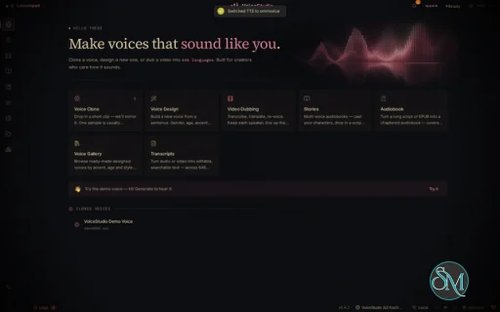
VoiceStudio is A Powerful Text to Speech and Voice Cloning Tool. It suitable for content creation, accessibility, presentations, narration, and other voice based projects.
(4.3)

Developer

VoiceStudio.sh

Category

Utilities

Operating System

Windows / macOS / Linux

Date Published

Tue Sep 01 2026

Review VoiceStudio v0.5.1

VoiceStudio is a useful text to speech application for users who want to turn written text into natural sounding speech. It is designed for people who need voice generation without having to record every sentence manually, making it suitable for content creation, accessibility, presentations, narration, and other voice based projects.

One of the main advantages of VoiceStudio is its focus on making voice generation accessible. Instead of requiring professional recording equipment, users can generate spoken audio from text and adjust the result according to their needs. This can save considerable time when producing longer narration or repeated voice content.

VoiceStudio can also be useful for experimenting with different voices and speaking styles. Depending on the supported engine and configuration, users may have control over characteristics such as speech rate, pitch, and other voice parameters. This gives more flexibility than a basic text to speech reader.

Another appealing aspect is its potential for voice cloning and AI based voice generation. These capabilities can be useful for creators who want a consistent voice across videos, tutorials, podcasts, or other digital content. However, voice cloning should always be used responsibly and with appropriate permission from the person whose voice is being replicated.

The application can also fit well into accessibility workflows. Converting text into speech can make written information easier to consume for users who prefer listening rather than reading. It can also be useful for proofreading, allowing writers to hear how their text sounds when spoken aloud.

VoiceStudio is not necessarily aimed at replacing professional voice actors in every situation. AI generated speech can still have limitations with pronunciation, emotion, pacing, and context. Results can vary considerably depending on the voice engine and the quality of the input text.

The learning curve will also depend on how many features you want to use. Basic text to speech is relatively straightforward, while more advanced voice customization and cloning features may require additional experimentation.

Overall, VoiceStudio is an interesting option for users who want convenient access to modern speech generation tools. It combines the practicality of text to speech with more advanced voice capabilities, making it useful for both casual users and content creators.

Download VoiceStudio v0.5.1 - Software Mirrors

VoiceStudio v0.5.1 for Windows

VoiceStudio_0.5.1_x64_en-US.msi | 162.22 MB

VoiceStudio v0.5.1 for macOS

VoiceStudio_x64.app.tar.gz | 109.5 MB

VoiceStudio_aarch64.app.tar.gz | 107.45 MB

VoiceStudio_0.5.1_x64.dmg | 107.84 MB

VoiceStudio_0.5.1_aarch64.dmg | 105.47 MB

VoiceStudio v0.5.1 for Linux

VoiceStudio_0.5.1_amd64.AppImage | 225.94 MB

Others Download related to VoiceStudio v0.5.1

uninstall.sh | 8.01 kB

uninstall.ps1 | 8.1 kB

VoiceStudio v0.5.1 Source Code

VoiceStudio v0.5.1 Source code (zip)

VoiceStudio v0.5.1 Source code (tar.gz)

VoiceStudio v0.5.1 Release Notes:

Highlights
  • OmniVoice generation on Apple Silicon now runs in a crash-isolated child, so fatal MPS memory exits no longer take down the local backend (#1697, #1698) — thanks ndntran14!
  • Model-load GPU exhaustion now returns a sanitized, actionable dubbing error, and readiness correctly attributes the shared model status to TTS (#1695)
  • Source-mode development now restarts an isolated backend crash without tearing down the UI, while repeated crash loops still stop loudly with diagnostics (#1690)
  • Dubbing playback now keeps an audible companion source when a WebView can render the preview picture but cannot decode its audio (#1692)
  • Model Catalogue engine rows now use the available desktop width and keep identity, runtime state, and actions from crowding one another (#1689)
  • VoiceStudio now acts as a local speech platform: other apps can trigger its native dictation or connect through versioned HTTP, WebSocket, JSON-RPC, CLI, and MCP transports (#1646)
  • A timed-out in-process dub transcription no longer starts a second WhisperX/CTranslate2 call over the abandoned native worker, preventing the overlapping access that preceded Windows 0xC0000005 exits (#1669)
  • Windows debugger termination code 0x40010004 is no longer misreported as a backend crash or charged against automatic restart recovery (#1663)
  • Studio now keeps one generation reservation across page changes, preventing a remount from stacking native jobs until the backend reports capacity busy or is killed under memory pressure (#1670)
  • Uploaded dubbing videos are normalized to browser-safe H.264/AAC before preview, preventing valid VP9, AV1, or Opus media from failing with “no supported sources” (#1644)
  • Dubbing now separates spoken and target languages, preserves translations through segment cleanup, and lets failed translations be retried or skipped without restarting the batch (#1654) — thanks Number16BusShelter!
  • Importing replacement SRT subtitles now keeps each cue bound to the best-overlapping source speaker and clone instead of resetting every line to a random default voice (#1660) — thanks invio-a11y!
  • Uploading a Dub preview no longer blocks every backend request while ffmpeg extracts its audio (#1667) — thanks tfreyd!
  • Docker quick starts now require the administrator key needed through container NAT instead of starting a UI whose protected actions return 403 (#1651) — thanks wd357dui!
  • WSL2 AMD containers now use the /dev/dxg ROCDXG bridge with actionable GPU diagnostics instead of silently falling back to CPU (#1655) — thanks wd357dui!
  • Ad-hoc voice-clone references now stay alive until cancelled or timed-out GPU work actually stops reading them, so prompt caching can finish instead of failing on a deleted temp file (#1668) — thanks tfreyd!
  • Dictation now stays bound to the app where it started and recovers locally from silent recognizer output (#1175)
  • The backend now answers within a second of launch and narrates its startup step by step (#1550)
  • Reporting a bug from an outdated build now offers the latest release first (#1547)
  • The backend is only announced ready once it can actually serve, and crash-loop restarts now pace themselves (#1548)
  • Invisible watermarking no longer stalls — or silently skips — the first take of a session (#1615)
  • Dub subtitles can be retimed, inserted, and merged in either direction from the segment table (#1612) — thanks invio-a11y!

Changed

  • Model Catalogue now uses one breathable workspace canvas with simpler pane and engine-family navigation instead of nested cards and scroll regions (#1685)
  • Linux source launchers now catch missing libxdo and GStreamer audio plugins before they can cause a linker error or an aborted, blank WebKit renderer (#1680, #1682)
  • Dictation now carries one native output session from shortcut-down through final delivery, restores text, HTML, image, or file-list clipboards only when untouched, keeps Wayland copy-safe unless current-focus insertion is explicitly enabled, and retries silent Sherpa speech only through an already-installed local ASR model (#1175)
  • The backend binds its port immediately and reports startup progress live — /health answers 503-with-step and a new /startup/progress endpoint lists every step while PyTorch, API routes, and database migrations load in the background, so "starting at step X" is never mistakable for "dead"; the desktop splash narrates each step (#1550)

Added

  • A bundled Rust loopback sidecar exposes dictation start/stop/toggle, focused-output sessions, discovery, and JSON-RPC; the backend adds versioned streaming events and a dependency-free CLI bridge for Herdr, coding agents, editors, desktop apps, and TUIs (#1646)
  • Headless NVIDIA and ROCm machines can now join as worker-only Docker Compose services with no published UI and durable protocol-v2 enrollment; update both machines together before reconnecting (#1638) — thanks jkrogers9862!
  • Linux ARM64 (Asahi Apple Silicon) support for the OmniVoice GGUF engine — a linux-aarch64 binary built with GGML Vulkan where the toolchain allows it, so Apple GPUs accelerate generation through the open-source Honeykrisp driver instead of falling back to CPU-only (#1641)
  • One-command install on every desktop OS: curl -fsSL https://voicestudio.sh/install | sh (macOS/Linux/WSL) or irm https://voicestudio.sh/install | iex (Windows) — the URL serves the right script per platform, and Windows gains a source installer (scripts/install.ps1) with a 3-OS CI smoke (#1626)
  • Per-line subtitle management in the dub table: a line's end time is editable alongside its start (typing a time and dragging its timeline edge now take the same path), lines merge with the previous row as well as the next (Ctrl/Cmd+Shift+M), and a new line can be inserted into the gap after any row (#1612) — thanks invio-a11y!
  • CI now enforces performance regression budgets on the hot paths — operation-count tests pin streaming TTS to one synthesis per sentence and cached dub re-mixes to zero re-synthesis; fast-path guards cover zero re-decoding and ⌈N/W⌉ native batch calls when enabled (#1594)
  • Default-engine dubbing now synthesizes several segments per forward pass instead of one call per line — the width follows the host's device headroom (1 on CPU and low-VRAM cards, up to 8), OMNIVOICE_DUB_BATCH_WIDTH overrides it, and engines without native batching keep the single-segment path (#1594)
  • /ws/tts now reports real time-to-first-audio, and its RTF measures synthesis alone so a slow client can't inflate it (#1594)
  • The locally cached AudioSeal watermark generator warms on a background thread ~35s after boot (OMNIVOICE_PRELOAD_WATERMARK=0 opts out; explicitly setting =1 may download it), so the first synthesis no longer serializes the audioseal import + model load inline — measured at ~42s on a cold filesystem, 3s short of a 90s client timeout (#1576) — thanks paoloantinori!
  • Voices you've cloned stay "warm" across restarts — encoded references now persist to disk (~10 KB each), so the first generation of a session skips the re-encode and any transcription pass; OMNIVOICE_PROMPT_DISK_CACHE=0 opts out (#1565)
  • Optional FlashInfer acceleration for the default engine on CUDA (OMNIVOICE_FLASHINFER=1, ~2.2x measured) — needs the optional flashinfer-python package; missing package or kernel failure logs why and falls back to the standard path (#1565)
  • The bug reporter notices when you're on an outdated build and offers the latest release before filing — with a "File anyway" escape hatch — and stamps a Build status line into every report so up-to-date reports are tellable from stale ones (#1547)
  • Settings → Performance & Device gains a compute-device override (Auto / CUDA / ROCm / XPU / MPS / CPU, or OMNIVOICE_DEVICE) — pin the device when auto-detect picks wrong; only devices your machine actually has are offered (#1557)
  • Opt-in 24-layer PocketTTS checkpoints via OMNIVOICE_POCKETTTS_24L — better prosody for it/de/es/pt at roughly 2x render time (still faster than real-time); the fast 6-layer model stays the default (#1613) — thanks paoloantinori!

Docs

  • Supported-version and install guidance now identifies 0.5.1 as the stable desktop and container release (#1687)
  • The Docker Hub overview now shows the current engine-switching demo, Model Catalogue, and gallery voice workflow (#1593)
  • The Docker Hub overview and install guide now show the v0.5 tags and the built-in API-key/share-PIN security model instead of obsolete v0.4 and no-authentication guidance (#1592)
  • The READMEs now lead with download buttons and a three-step first-clone walkthrough, and a new benchmarks page anchors measured per-engine/per-device numbers on the in-repo harness (#1555)
  • Every engine now has its own guide — 21 new pages under docs/engines plus an index covering all 16 TTS and 11 ASR engines, linked from both READMEs (#1556)
  • The OmniVoice guide now covers combining style attributes with a reference clip (consistent instruct stabilizes cloning; the reference wins conflicts), inline pronunciation control (pinyin / CMU phonemes), and corrects the claim that the default engine can't do voice design — it can, from attributes (#1565)

Fixed

  • Workspaces now measure their responsive width when the post-bootstrap shell actually mounts, so native UI scaling reflows Projects and History instead of crushing the Dubbing demo into unreadable columns (#1683)
  • Dubbing keeps the source-language selector visible after a local file is chosen, so ASR can be pinned before transcription starts (#1678) — thanks Lonki-lomki-cloud!
  • First-run media-engine downloads become available to TTS immediately without a restart, and missing media-process failures now point to repair controls (#1677) — thanks farhataligpt-dev!
  • Source installs on AMD GPUs honour OMNIVOICE_TORCH_VARIANT=rocm: bun run desktop now swaps in the ROCm torch wheel after uv sync and launches the backend without re-syncing, instead of silently reverting to the CPU-only CUDA build on every start (#1665) — thanks uberclokr!
  • bun run desktop on a fresh clone no longer fails with "resource path ../../frontend/dist doesn't exist" — the dev launcher creates the placeholder Tauri resource directory before compiling (#1664) — thanks uberclokr!
  • macOS no longer loses TTS after the first request when Python lacks os.waitid; subprocess ownership now uses a safe waitpid fallback without risking reused process groups (#1656) — thanks paoloantinori!
  • Desktop startup, Retry, reset, uninstall, shutdown, and crash recovery now share one backend lifecycle owner; quitting interrupts first-run installers and gracefully drains then force-cleans the full backend process tree, so overlaps cannot duplicate or orphan it (#1635) — thanks Xohaibxobi!
  • Large Stories and Audiobook projects now persist in IndexedDB instead of overflowing the omnivoice.app localStorage envelope, with quota-safe migration and orderly exit/reload flushing (#1636) — thanks leodzai!
  • OmniVoice and its crash-isolated subprocess now route to AMD ROCm GPUs instead of warning and falling back to CPU (#1629) — thanks j4r3kb!
  • Dictation now cancels pending startup work, capture resources, sockets, and timers when the capture widget closes, preventing late work against a destroyed webview (#1645)
  • Streaming generation failures now show recognized recovery guidance and appear in Diagnostics instead of only returning a generic error (#1607)
  • The worker-capacity transport test no longer races its own setup: the 1-slot limit now goes through the enrollment handshake instead of mutating client config after connect, where the server's stream-open ConfigUpdate (carrying the registered capacity of 2) could overwrite it and fake an over-accept; failed CI twice on 2026-08-21 (#1630)
  • Moving words across a speaker boundary in a dub — merging two lines and splitting them again — no longer dubs the second half in the first speaker's voice; each half now keeps the speaker, voice, direction, gain, and language of whoever actually says it (#1612) — thanks invio-a11y!
  • Dictation on a WebView that refuses a 16 kHz audio context (WKWebView) now low-passes before downsampling, so frequencies above 8 kHz stop folding into the speech the recognizer is fed (#1610)
  • A microphone context that cannot be resumed now reports a mic error instead of leaving the dictation pill on "Listening" while capturing nothing (#1610)
  • Dictation no longer retains a whole session's audio for silent-model recovery — an open mic grew that buffer by ~115 MB an hour; the recent two minutes are kept instead (#1610)
  • The clipboard-delivery status is now translated in all 21 languages, so Wayland users — where clipboard delivery is the default — no longer see an English string (#1610)
  • A native sherpa-onnx load failure of any exception type now degrades to "engine unavailable" instead of taking the dictation WebSocket down (#1610)
  • Dictation now ships Whisper Tiny as its one cross-platform default, avoiding Parakeet's measured empty decoding on Windows while keeping Parakeet selectable behind runtime fallback (#1175)
  • Re-mixing a dub no longer decodes, rewrites, and re-reads every cached segment — same-rate cached audio is reused directly (and rejected if truncated), switching timing modes can't reuse slot-truncated audio as natural-rate, and RVC respects natural-rate modes (#1594)
  • PocketTTS French works again — pocket-tts only ships a 24-layer French model and rejected the name the sidecar asked for, so every French request failed at model load; French now always loads french_24l (#1613) — thanks paoloantinori!
  • Installing IndexTTS 2.5 no longer fails claiming an interrupted download — the weights repo ships config.yaml and VoiceStudio demanded a config_v2_5.yaml that exists in no upstream release; both names are accepted, so a hand-renamed checkout keeps working (#1611) — thanks zuiaiyutu!
  • IndexTTS 2.5 no longer has long-text generation killed at 60 seconds — the sidecar now proves it is alive every 5 seconds while infer() runs, and its deadline rises to 900s (OMNIVOICE_INDEXTTS_RECV_TIMEOUT_S) (#1611) — thanks zuiaiyutu!
  • The OpenAI-compatible /v1/audio/speech route now reuses the shared cached engine for explicit model ids instead of constructing a fresh engine — and its sidecar/model load, a ~28s floor per call for subprocess engines — on every request, with the same single-engine-resident discipline /generate applies (#1614) — thanks paoloantinori!
  • The setup wizard's RAM check no longer blocks 8 GB machines whose OS reports ~7.8 GB usable — the thresholds now tolerate reserved memory, and OMNIVOICE_RAM_PREFLIGHT=0 turns a genuine block into a warning for those who accept the OOM risk (#1618)
  • Invisible watermarking now runs eagerly instead of through torch.compile — AudioSeal's lazy compile sent the first embed of every session into Inductor's C++ codegen, which failed outright on macOS hosts whose toolchain couldn't serve it and shipped the audio unmarked after a 30-40s wait; first embed drops from 9.70s to 0.26s (#1615) — thanks paoloantinori!
  • The macOS Accessibility blocker now rechecks while visible and closes as soon as the grant is enabled instead of keeping a stale permission prompt on screen (#1609)
  • The dubbing editor's video and transcript columns can now be resized by pointer or keyboard, and the chosen split persists across launches (#1571) — thanks invio-a11y!
  • CPU-only synthesis now gets a bounded ten-minute execution budget, and a render that exhausts it is reported as a compute timeout instead of misleading "generation capacity is busy" queue pressure (#1588) — thanks ChienNguyen1111!
  • Rapid Launchpad ↔ Dub navigation now replaces the workspace DOM owner cleanly, so late media/waveform cleanup cannot trigger React's insertBefore crash (#1590) — thanks nicolas-jacques!
  • Watermark embedding failures now log the full traceback instead of just the exception message, so a silently-unmarked-audio incident (audio passes through unmarked by design) is diagnosable from the log alone (#1576) — thanks paoloantinori!
  • Dubbing now recovers rapid two-speaker exchanges when diarization collapses them, defaults new projects to lip sync without overwriting saved timing choices, and keeps the editor usable on narrow screens (#1584) — thanks victordonat0!
  • OMNIVOICE_ASR_BACKEND=omnivoice now selects the PyTorch-native Whisper path, so the documented ROCm escape hatch no longer fails as an unknown engine (#1582) — thanks patmansk!
  • Network Sharing from Windows MSI/portable installs now serves the bundled web interface to LAN devices instead of redirecting them to their own localhost (#1589) — thanks TWIISTED-STUDIOS!
  • Exported dubbed videos now mark the dubbed language as the default audio stream while keeping Original available as an explicit choice (#1575) — thanks invio-a11y!
  • Cloning references can no longer exhaust system memory: transcript-free clips up to 75 seconds are searched in five bounded passages, longer clips ask to be trimmed, and supplied transcripts remain capped at 20 seconds to preserve alignment (#1578) — thanks ACKAPOB!
  • Stored artifact subpaths now resolve after moving a data directory between Windows, macOS, Linux, and Docker, while traversal and symlink escapes remain blocked (#1559) — thanks Eman-Yousaf!
  • A remote browser hitting an API-key-configured server's admin 403 now gets the API-key login form instead of endless console 403s, while desktop and PIN-only/no-key servers keep the plain loopback error so guests are never offered a login no key can satisfy (#1568) — thanks paoloantinori!
  • The crash-isolated ASR sidecar and its download preflight now agree on which model to load — setting the shared faster-whisper model variable applies to both variants instead of the sidecar quietly using a different one (#1556)
  • "Ready" now requires the deep health probe (a working database-backed route), not just the identity probe — a backend whose install broke underneath can no longer be announced up while every real request fails (#1548)
  • Supervisor restarts after repeat crashes now back off (immediate, then 5s, then 15s) instead of respawning back-to-back, so a tight crash loop can't burn the whole restart budget in seconds (#1548)
  • The Linux desktop cleanup regression test now isolates build artifacts, so an existing developer build can no longer change its result (#1566)
  • Renaming, deleting, or revoking consent on a voice (and starring/clearing history, recording exports) now live-updates every open tab again — the sync routes' WebSocket events were silently dropped, which could look like "all my voices are gone" (#1561) — thanks paoloantinori!

CI

  • Project agents now share pinned Vite and FastAPI skills from skills.sh (#1594)
  • Weekly full-history secret scans no longer mistake the Ed25519 private-key type name for committed key material (#1591)

Linux x64 artifacts


43753aeb1f78e9318d8a4df97e45b76384cad5d88e6be423d696413f8329492c  VoiceStudio_0.5.1_amd64.AppImage
5bd13d39f8ccf8eb3ffedbefc27609ffa7a8cb90d24a8c5a421d19b4343d8578  VoiceStudio_0.5.1_amd64.AppImage.sig

macOS Intel artifacts


14a6d3dac76bd28ead71663a274d084d8d2d2a271301f4863a1691c45611236c  VoiceStudio_0.5.1_x64.dmg
9fb9e883cb2ee2bdde21d5d455d0e5334b6d2fb55541acdbd9aae130dc78876d  VoiceStudio.app.tar.gz
aed7f2ccd25b78d64dccc005e76b266ac0ebff03f97539b52b047fb9540af4fc  VoiceStudio.app.tar.gz.sig

Windows x64 artifacts


0e0a9b3ef7d4c48243bae2b12f610c5bc991bbb127e17700a410c24063cab2a6 *VoiceStudio_0.5.1_x64_en-US.msi
a3f7d688585b7532543accb8e98cc2fb1056f686bd4bc3358969a02f2f818cd3 *VoiceStudio_0.5.1_x64_en-US.msi.sig

Contributors

Thank you all 💜 @debpalash @paoloantinori @Eman-Yousaf @MhAhmadAli @uberclokr @victordonat0

Install

Download packages from the latest release. First launch creates a managed Python environment and downloads the default model. Later launches reuse both.

Note

On macOS, first launch needs a one-time right-click → Open approval. Intel Macs cannot run the local Python backend; use a remote backend instead.

First voice

  1. Launch VoiceStudio and open Voice Cloning.

  2. Add a clean voice sample. Three seconds works; 5–15 seconds usually gives a better prompt.

  3. Enter text, choose a language, then select Generate.

Run from source

Install the development prerequisites, then:

git clone https://github.com/debpalash/VoiceStudio.git
cd VoiceStudio
bun install
bun run desktop

Use bun run dev for the browser UI. See Contributing for services, tests, and platform packages.

If setup fails

Pros

  • Convenient text to speech generation

  • Useful for narration and content creation

  • Can reduce the need for manual voice recording

  • Voice customization options

  • Useful for accessibility

  • Potentially useful for consistent voice production

Cons

  • Voice quality can vary depending on the selected engine

  • AI voices may still sound less natural in some situations

  • Advanced features can require experimentation

  • Voice cloning requires responsible use and proper authorization

Final Verdict

VoiceStudio is a capable voice generation tool for anyone who needs to convert text into speech quickly and consistently. Its usefulness extends from simple accessibility applications to more creative projects such as video narration and digital content.

It is not a complete replacement for professional voice recording, but its convenience makes it a practical addition to an AI focused content creation workflow.

Comments on VoiceStudio v0.5.1