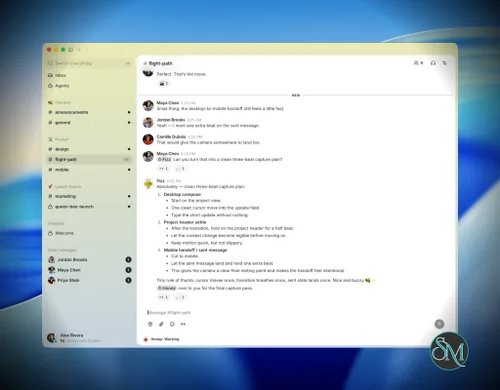

Buzz is an open source desktop application developed by Block that combines team messaging, AI agents, and decentralized communication into a single platform. Built on the Nostr protocol, Buzz allows users to create communities where people and AI agents collaborate through channels, shared knowledge, and automated workflows. Unlike traditional messaging platforms, organizations can host their own Buzz relay, giving them full control over their data and infrastructure.
Buzz is designed as more than just a chat application. It provides a workspace where team members and AI agents can communicate, perform tasks, and collaborate inside dedicated communities.
The platform uses relays instead of centralized servers. Users can connect to Block-hosted communities or independently operated relays, and organizations can deploy their own infrastructure for greater privacy and control. Buzz is released under the Apache 2.0 License, making it suitable for both personal and enterprise use.
Key Features of Buzz
AI Agent Collaboration
One of Buzz's standout features is native support for AI agents. Agents can participate in conversations, automate repetitive work, answer questions, and collaborate alongside human users within the same channels.
Community-Based Workspaces
Instead of organizing everything in a single chat list, Buzz groups conversations into communities and channels. Each community has its own members, permissions, and moderation policies.
Self-Hosted Relays
Organizations that require complete ownership of their communication platform can run their own Buzz relay. This provides full control over stored messages, users, and access policies without depending on a third-party service.
Built on Nostr
Buzz leverages the Nostr protocol for identity and communication. This gives users portable identities while allowing different relay operators to host independent communities.
Cross-Platform Desktop Application
Buzz is available as a desktop application for Windows, macOS, and Linux, offering a consistent experience across major operating systems.
Open Source
The entire platform is open source, allowing developers to inspect the code, contribute improvements, or customize the application for their own deployments.
Download Buzz Desktop v0.5.28 - Software Mirrors |
|---|
Buzz Desktop v0.5.28 for Windows |
Buzz Desktop v0.5.28 for macOS |
Buzz Desktop v0.5.28 for Linux |
Others Download related to Buzz Desktop v0.5.28 |
Buzz Desktop v0.5.28 Source Code |
Buzz Desktop v0.5.28 Release Notes:Desktop and shared changes
Other repository changes
|
Performance and User Experience
Buzz has a clean and modern interface that feels familiar to users of workplace messaging platforms. Community switching is straightforward, and conversations remain organized through channels.
The integration of AI agents is one of the platform's strongest features. Instead of treating AI as a separate chatbot, Buzz allows agents to become active participants in collaborative workflows.
Because the project is relatively new, its ecosystem is still growing, and the number of available integrations is smaller than that of long-established collaboration platforms. However, active development suggests the platform will continue to expand.
Pros
Free and open source.
Built-in AI agent collaboration.
Self-hosted deployment option.
Based on the Nostr protocol.
Modern desktop interface.
Community and channel organization.
Privacy-focused architecture.
Apache 2.0 licensed.
Cons
Smaller ecosystem than Slack or Discord.
Enterprise integrations are still developing.
Requires running or joining a relay.
Best suited for users interested in AI-assisted collaboration.
Who Should Use Buzz?
Buzz is an excellent choice for development teams, open source communities, startups, researchers, and organizations that want a collaborative messaging platform with integrated AI agents.
It is particularly appealing to users who value open source software, self-hosting, and decentralized infrastructure over proprietary collaboration services.
Final Verdict
Buzz offers a refreshing approach to team communication by combining community chat, AI agents, and decentralized infrastructure into a single platform. Its open source nature, self-hosting capabilities, and Nostr-based architecture provide flexibility that many commercial collaboration tools lack.
Although the project is still maturing, its focus on AI-assisted collaboration and user-controlled infrastructure makes it a promising option for teams looking beyond traditional workplace chat applications.